- Arundas.P.P
- 01 Aug 2026
All You Need to Know About the Kerala Encumbrance Certificate
An encumbrance certificate in Kerala confirms whether a property is legally free or has financial liabilities before a sale, loan, or transfer. It is one of the first documents any buyer or seller should check.
It verifies ownership history and also proves the property has no active loans or legal arguments
This page walks through what the certificate includes, how to apply for it online,cost of certificate, and what both buyers and sellers should watch for during a property transaction in Kerala.
What Is an Encumbrance Certificate in Kerala and Why Does It Matter?
Encumbrance certificate (EC) is an official record issued by the Kerala Registration Department. It lists every official transaction for a property during a specific time .
It includes sale deeds, mortgages, gift deeds, and leases that are connected to a land. It helps to ensure that property is safe to buy before money changes hands
It helps buyers to avoid a hidden loan against the property. Sellers use it to prove the land is transferable without legal complications.
Banks check this because ownership problems or hidden loans can cause them to deny your mortgage. An unclear title affects the loan a bank is willing to offer, and some lenders decline financing altogether if the EC shows an unresolved loan.
The certificate is jurisdiction-specific. Records are maintained by the sub-registrar office covering that particular village or locality, so the correct office matters as much as the correct survey number.
An EC does not certify ownership on its own. It simply confirms what has been registered against the property during the period requested, which is why it works best alongside other title documents rather than in isolation.
How Can You Apply for an EC Online in Kerala?
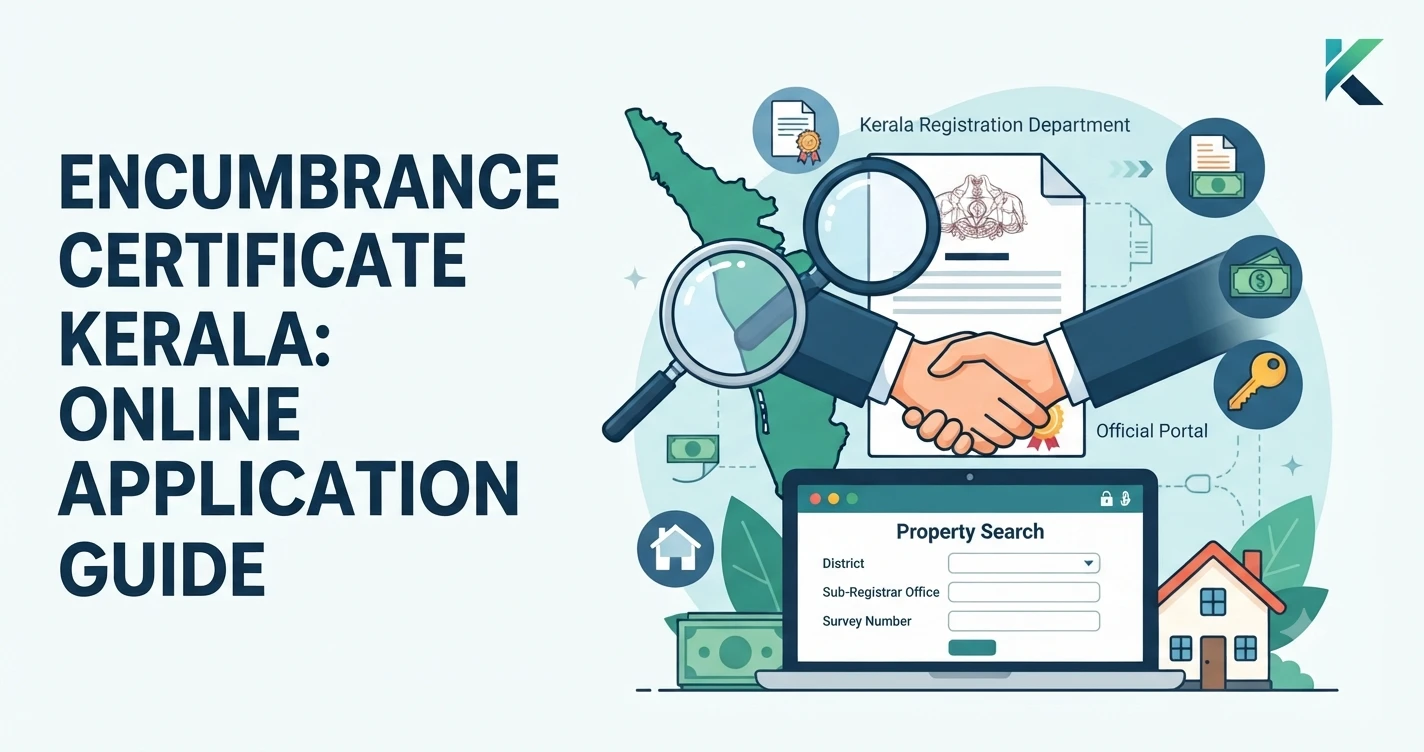
You can apply for an encumbrance certificate in Kerala online through the Registration Department's official portal. There is no need to visit the sub-registrar office in person.
Applicants can track their EC certificate online application status from home.
Steps that involves :
Registering on the official e-services portal with basic details
Entering the property's survey number, village, and district
Selecting the date range for the encumbrance search
Paying the applicable fee online and submitting the request
Once you submit the application, the request moves to the relevant sub-registrar office for verification against physical or digitized registers. Applicants receive a reference number to track progress on the portal.
Some applicants confuse this with Kaveri online services Kerala users occasionally search for. Kaveri is actually Karnataka's land record system, not Kerala's.
Kerala runs its own dedicated registration portal, separate from Kaveri. Knowing this distinction avoids wasted time on the wrong platform during a property certificate search Kerala buyers and sellers.
A practical tip for first time applicants: Always double check the village and survey number against the actual sale deed rather than a tax receipt, since small mismatches are the cause of application errors.
What Documents and Fees Are Required for an EC Application?
An EC application in Kerala needs proof of property identity and applicant details and also requires the fee based on the requested search period.
Most Common reasons for delay or reject the application are missing survey details Getting this right the first time saves a repeat trip through the process.
Documents generally required:
Property address, survey number, and sub-registrar office jurisdiction
Applicant's identity proof
Details of the years for which the certificate is needed
Some applicants also attach a copy of the parent sale deed. Parents' deed is not always mandatory, but it helps the sub registrar office match records faster when property boundaries or names have changed over the years.
Fees are calculated per year of search. Whether the request is filed online or offline may vary slightly depending on the sub-registrar office.
Longer search periods cost more overall, since the fee is charged per year rather than as a flat amount. A 30-year search will naturally cost more than a 13-year search covering the same property.
Always look at the official site for exact fees. Do not trust third-party estimates.
How Long Does Processing Take, and Who Can Help With It?
An encumbrance certificate in Kerala usually takes a few working days to process once the application and fee are submitted correctly.
Older properties can take longer.Because records that still need manual verification at the sub-registrar office push the timeline out further, so it helps to apply well before a transaction deadline.
You can apply for a Kerala EC yourself or pay an expert to do their support matter most for older properties. Digitized records for these are often incomplete or split across multiple sub-registrar offices, and someone familiar with the local records office can often resolve mismatches faster than a first-time applicant.
Entering the wrong survey number, requesting too short a search period, or assuming a clear EC guarantees title accuracy on its own are the most common mistakes, so make sure all are correct.
An encumbrance certificate only reflects what has been formally registered. It should always be read alongside the parent document and recent tax receipts, not treated as the sole proof of clean title.
If you're currently comparing a flat for sale in Kochi or a house for sale in Kochi, requesting the EC early is a simple way to build due diligence into the buying process before you sign anything.
What Should Buyers and Sellers Check Beyond the EC?
Buyers should treat the EC as one part of a larger checklist. Confirming the seller's identity matches the registered document, checking property tax receipts, and verifying survey boundaries with a licensed surveyor.
Sellers who have a clear EC ready can negotiate faster and register without delays. Both parties should also confirm there are no pending court cases tied to the property. The EC won't show legal disputes until they are officially registered , so a basic legal check with a property lawyer is a sensible extra step for higher-value transactions.
For jointly owned properties, it helps to confirm that all co-owners are listed correctly as transacting parties on the registered document. Any mistakes will delay getting your EC and registering the sale
Key Takeaway
An encumbrance certificate confirms a property's legal and financial history for a chosen period. It can be applied for online through Kerala's official registration portal.
The process requires basic property and applicant details, involves a period-based fee, and typically takes a few working days to process. Professional help is available but not mandatory for most straightforward applications.
Frequently Asked Questions


Trending Property Searches in Kerala
Categories
Categories