- Arundas.P.P
- 19 Sep 2026
Sustainable Building Designs: Financial Benefits and Costs
Sustainable building design or sustainable architecture is a method to create structures that reduce environmental negative impacts and improve human health through efficient resource use. It is also known as a green building. This page discusses what the term means, what it costs against regular construction, and how buyers and sellers can judge a genuinely green home before signing anything.
Table of Contents
What Is Sustainable Design in Architecture?
Cost Comparison with Traditional Construction
Which Renewable Energy Systems Offer the Best Return for Kerala Homes?
What Are the 7 Principles of Sustainable Construction?
How Can You Design a Sustainable House Step by Step?
How Does Rainwater Harvesting Integrate into a New Home Design?
What Certifications Confirm a Building Is Genuinely Sustainable?
What Are the Top Sustainable Buildings in India Worth Knowing About?
How Do You Find Architects Specializing in Sustainable Design?
Which Companies Offer Sustainable Design Services in India?
What Mistakes Should Buyers Avoid When Evaluating Green Homes?
What Is Sustainable Design in Architecture?
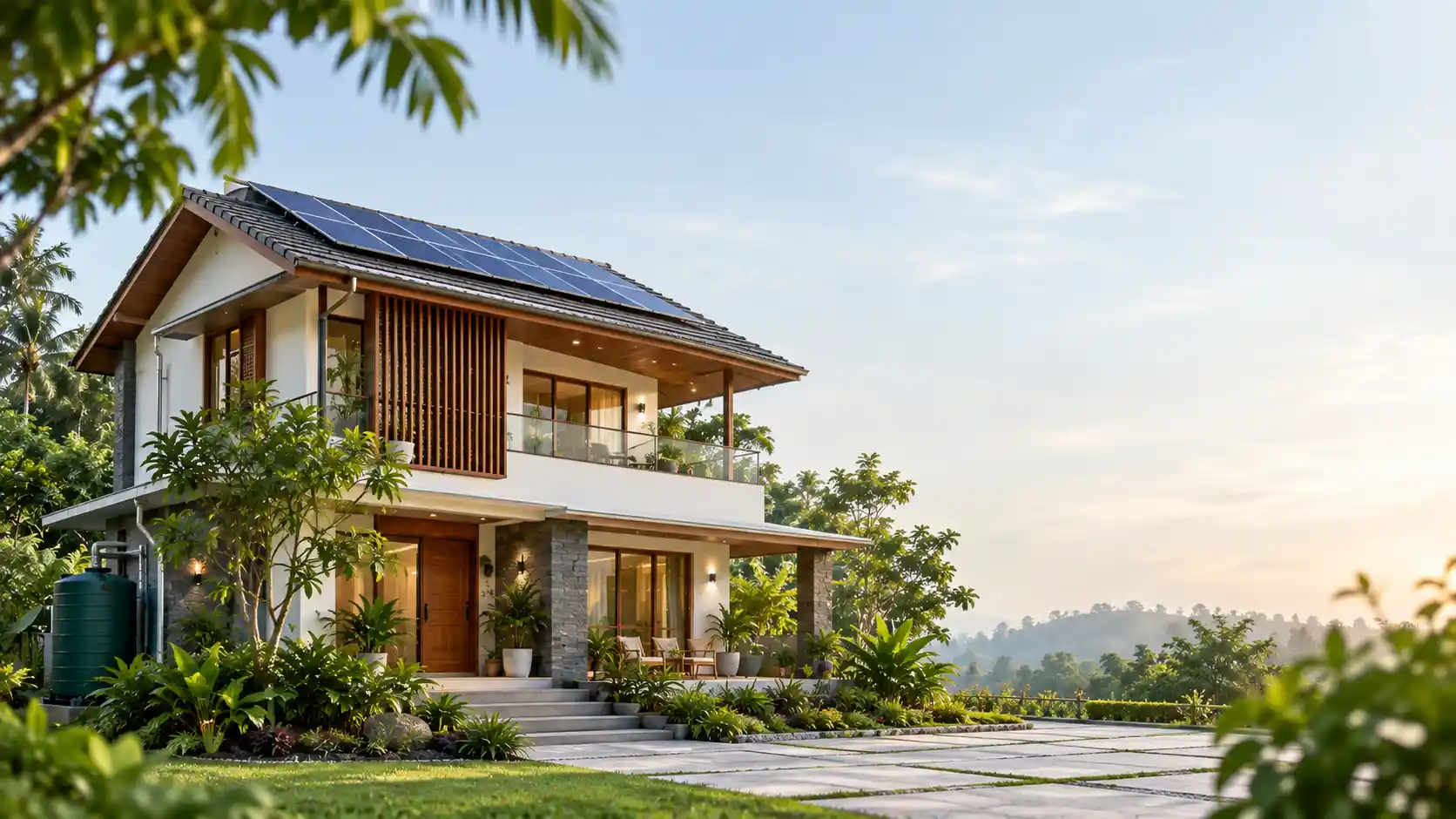
Sustainable design in architecture means planning a building to use less energy, less water, and using recycled resources from construction to demolition. It treats passive design, renewable energy, and resource-efficient materials as one connected system.This concept practices orientation, natural ventilation, natural daylight, insulation, and low-carbon materials such as sustainable timber or fly-ash bricks. For Kerala's humid climate, this usually means designing for shade and water management first, and adding technology like solar panels
How Do Sustainable Building Designs compared to standard buildings in 2026
Sustainable building designs typically have high cost at the construction stage, mostly because of solar systems, better insulation, and certified materials. In 2026, that gap is dropping as more suppliers stock certified low-carbon materials locally, and the premium often reverses once energy cost, water cost, and maintenance cost are counted over the building's lifecycle.
For a property buyer, sustainable building designs pay back mostly through electricity and water bills, not an instant discount, so this decision works better looking as a long-term investment. In my experience reviewing listings on our website, homes with a working solar panel and rainwater harvesting are of high value in resale talks, because buyers now ask about the electricity bill almost as often as the layout.
From my experience, a homeowner in Kozhikode spent more to install solar panels and built a rainwater tank. He noticed a lower electricity bill once the system was running through the first summer, based on what they later shared with their architect. Cases like this are becoming more common as more buyers ask contractors for actual utility numbers
Which Renewable Energy Systems Offer the Best Return for Kerala Homes?
Solar systems currently offer the most practical return for Kerala homes in 2026,because of it given consistent sunlight, falling panel costs, and support. Other renewable options rarely work for large systems of a single residential plot.
The Ministry of New and Renewable Energy notes that rooftop solar remains the most accessible, subsidised renewable option for Indian households.The Bureau of Energy Efficiency also publishes ratings that help buyers compare appliances and building systems before purchase.
What Are the 7 Principles of Sustainable Construction?
Sustainable construction rests on seven connected principles: passive design and orientation, energy efficiency, water conservation, sustainable material sourcing, waste reduction, indoor air quality, and lifecycle thinking about long-term performance.
For better results these 7 principles work together. A well-oriented home with poor materials still wastes resources, and good materials in a badly oriented home still overheat. This is the standard that certification bodies like IGBC and GRIHA use to assess a project.
How Can You Design a Sustainable House Step by Step?
Start with orientation and shading before adding any technology, since Kerala's cooling load is driven mainly by solar heat gain on west-facing walls and roofs. Passive choices reduce the load technology later has to offset.
A practical sequence looks like this:
Orient the plan to limit direct west sun and plan window placement for cross-ventilation.
Choose insulation, shading devices, and reflective roofing to cut passive heat gain.
Add rainwater harvesting and, where feasible, greywater reuse for gardens.
Select LED lighting and energy-efficient appliances rated by BEE.
Consider a green roof or vertical garden if the site and structure allow it.
Bring in a GRIHA or IGBC accredited professional if you plan to pursue formal certification.
Skipping step one and jumping straight to solar panels is a common mistake that limits savings later.
How Does Rainwater Harvesting Integrate into a New Home Design?
Rainwater harvesting works best when it is planned into the architectural drawings, not added after construction. A rooftop collection network, filtration unit, storage tank, and recharge pit for overflow form the basic setup.
Kerala's heavy monsoon makes this system unusually productive, so even a modest roof area can meaningfully cut dependence on borewell or municipal water. Builders typically size the tank against roof area, rainfall, and household demand, then route overflow to a recharge pit so it replenishes groundwater instead of running into stormwater drains.
What Certifications Confirm a Building Is Genuinely Sustainable?
Formal certification is the clearest way to confirm a sustainable building design meets a verified standard rather than a marketing claim. In India, the Indian Green Building Council and GRIHA remain the most relevant domestic systems in 2026, alongside international marks like LEED and ISO 14001.
Each certification checks energy performance, water efficiency, material sourcing, and indoor air quality before awarding a rating. Buyers should ask for the actual certificate and rating level, since self-declared "green" labelling without third-party verification carries little weight.
What Are the Top Sustainable Buildings in India Worth Knowing About?
India already has several widely cited sustainable buildings that show these principles at scale, even though most are commercial rather than residential. The CII-Sohrabji Godrej Green Business Centre in Hyderabad was among the first buildings in India to receive LEED Platinum certification and is often used as a reference project.
Other cited examples include the Suzlon One Earth campus in Pune, built around natural ventilation and daylighting, and Pearl Academy in Jaipur, which borrows stepwell-inspired passive cooling from traditional Indian architecture. These same strategies scale down to a single residential plot with the right architect.
Heading into 2026, the update worth noting is at the residential scale rather than the landmark scale. More Kerala homebuilders are now applying for GRIHA pre-certification at the design stage instead of treating it as an afterthought, a shift that mirrors what large commercial projects did roughly a decade earlier.
How Do You Find Architects Specializing in Sustainable Design?
Look for architects who hold an IGBC Accredited Professional credential or GRIHA trained professional status, then ask for completed projects with real post-occupancy performance data, not just design renders.
A credible architect should explain trade-offs clearly: why a particular orientation was chosen, why one insulation material was picked over another, and what payback period to expect from the proposed solar and water systems. If comparing a custom build against a ready-built option, browsing listings such as a house for sale in Calicut or a house for sale in Thrissur shows how sustainable features are already being described in real listings today.
Which Companies Offer Sustainable Design Services in India?
Rather than naming a fixed list, buyers are better served by checking credentials: firms registered with the Council of Architecture, architects with IGBC or GRIHA accreditation, and consultants who can show completed, certified projects.
National design firms with dedicated green building practices, along with Kerala-based architects who have taken GRIHA or IGBC training, are a safer starting point than firms that only advertise "eco-friendly" language without a certification behind it. Ask directly which certification, if any, the firm's past projects achieved.
What Mistakes Should Buyers Avoid When Evaluating Green Homes?
The most common mistake is trusting marketing language, terms like "eco villa" or "green home", without checking for an actual certificate or performance data. A solar panel on the roof does not by itself make a building sustainable.
Other frequent mistakes include ignoring orientation in favour of technology, skipping a water audit before installing rainwater harvesting, underestimating the maintenance cost of green systems, and judging by construction cost alone instead of lifecycle cost. Buyers on Thithithara, a real estate website in Kerala, are encouraged to ask sellers for documentation, not just descriptions, before treating a listing as genuinely sustainable.
Final Thoughts
Sustainable building designs in Kerala generally cost more to build but less to run, a trade-off that favours buyers who plan to hold the property for several years. Orientation, water systems, and certification matter more than any single piece of technology. Whether you are buying, selling, or simply researching real estate in Kerala in 2026, verifying credentials will serve you better than marketing claims. Visit thithithara.com to browse verified listings and compare homes built with these principles in mind.
Frequently Asked Questions

Trending Property Searches in Kerala
Categories
Categories